
Epoxy Floors in Desert Heat, UV & Hot Tires: A Southern Utah Guide
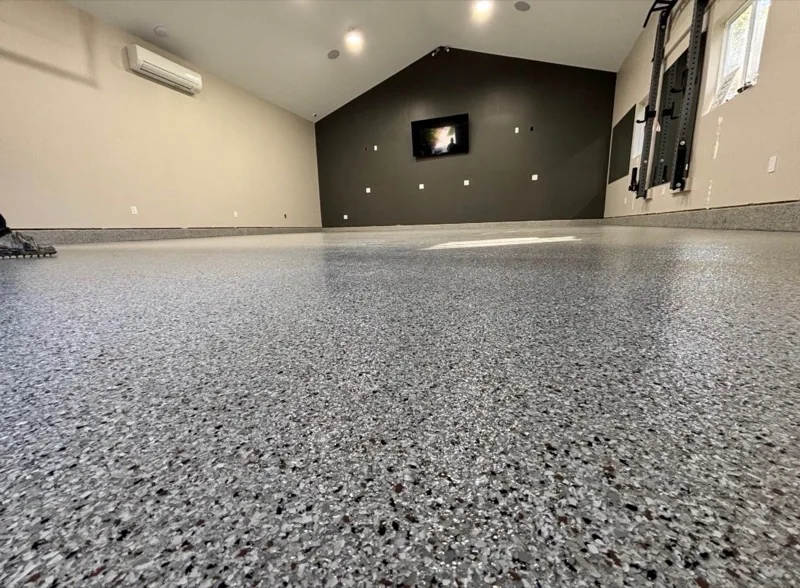
Quick answer: In St. George, epoxy floors fail mainly from hot-tire pickup, UV yellowing, and heat-rushed installs. The fix is diamond grinding for a mechanical bond, a thick high-solids base, and a UV-stable aliphatic topcoat such as polyaspartic, installed early in the day when slabs are cooler and fully cured before parking.
St. George is one of the hottest places in Utah, and its climate is tough on floors in ways that guides written for Ohio or Oregon never mention. This guide covers the four big desert factors — heat, hot tires, UV, and dust — plus monsoon storms and southern Utah soils, and what a coating system needs to survive them.
1. Heat: working time, cure, and slab temperature
Summer highs in St. George regularly pass 100°F from June into September. Resin chemistry speeds up as temperature rises: a batch that gives 30 minutes of working time on a mild morning can give a fraction of that on a hot afternoon. Rushed coats level poorly, trap bubbles, and bond less reliably. What we do:
- Start critical coats early in the morning, before the slab heats up
- Check slab temperature (not just the weather app) before mixing
- Mix smaller batches and move quickly with larger crews on big floors
- Keep doors partly closed and shade the work area where practical
- Schedule large metallic floors for cooler months when possible
Heat also helps: floors cure faster, so walk-on times are often shorter in summer. We give you written walk-on and park-on times for your actual conditions.
2. Hot-tire pickup: the #1 garage coating failure here
After a drive on summer asphalt, tires get hot and soft. When you park, the tire's rubber and plasticizers soften any weak coating under it. As the tire cools, it grips the film; when you back out, it pulls the coating off in the tire's shape. That's hot-tire pickup, and it's why so many DIY kits in Washington County peel in the first summer.
Hot-tire pickup comes down to three things:
- Bond: acid etching leaves a weak surface; diamond grinding opens the concrete so the base coat locks in mechanically.
- Thickness: water-based kits and paints go on a few mils thick. A professional system is several times thicker, with a high-solids base and broadcast layer.
- Topcoat hardness and cure: a hard, chemical-resistant topcoat (polyaspartic is common) resists softening; parking too early on any coating invites trouble.
Compare systems in garage epoxy vs paint.
3. UV: why topcoat chemistry matters in southern Utah
Southern Utah gets intense, high-elevation sun most days of the year. Standard epoxy is aromatic; UV breaks it down so it ambers (turns yellow) and can chalk. On a gray or white floor, that yellowing is obvious. Aliphatic topcoats — polyaspartic and aliphatic polyurethane — are UV-stable and keep their color. That's why we finish garages with open doors, casitas with big windows, and covered patios with an aliphatic topcoat. Full comparison: polyaspartic vs epoxy.
Tip: note which way your garage faces. West-facing doors take the afternoon sun at its hottest and are the first to show UV damage on the wrong coating.
4. Red dust and hard water
Fine desert dust is abrasive. Tracked in on tires and shoes, it slowly dulls any topcoat, and wind storms push it under the garage door. Hard water from sprinklers and car washing leaves white spots. A flake floor hides both between cleanings; a glossy solid or metallic floor shows them. Blow out or sweep dust weekly and rinse with a pH-neutral cleaner.
5. Monsoon storms and outdoor concrete
From about July to September, monsoon storms can dump heavy rain and mud in minutes. Garages take in wet tires and runoff at the door. A sealed floor makes that a squeegee job, and texture keeps footing safe. Outdoor slabs — patios, pool decks, entries — face full sun, standing water, and big day-night temperature swings, so we're selective about coatings outside and will tell you honestly when another finish is a better choice.
6. Soils, cracks, and slab movement
Parts of the St. George area have expansive clays and gypsum-bearing soils that can shrink, swell, or dissolve with water, and many local slabs show cracks from that movement. We repair cracks and detail control joints before coating so the floor looks uniform. A coating is not a structural fix, though: if a crack is actively moving, it can reflect through, and we'll flag that during the estimate.
7. Snowbird and seasonal garages
Garages closed up for the summer while owners are away can get very hot with no airflow. A properly cured, UV-stable system handles that fine; the bigger issue is dust that settles for months. A rinse before you leave and when you return keeps the finish looking new.
The desert-ready system, in one list
- Diamond grinding with dust extraction
- Crack, spall, and joint repair
- High-solids base coat with real film build
- Full flake broadcast (or metallic/solid, chosen with its trade-offs in mind)
- UV-stable aliphatic topcoat, usually polyaspartic
- Heat-aware scheduling and written cure times
Where we see this most
Heat and UV matter everywhere we work, but especially in west-facing garages in Washington and Little Valley, sun-filled casitas in Ivins, shops with open bay doors in Hurricane, and older slabs in Bloomington. In higher, colder Cedar City, freeze-thaw and road salt join the list.
Desert Heat & UV Guide: common questions
What is hot-tire pickup?
Hot-tire pickup is when a hot tire softens a floor coating, bonds to it, and pulls it off the slab as the car backs out. It shows up as tire-shaped peeled patches. It happens most with thin, water-based paints and kits applied over acid-etched or unground concrete.
How do you prevent hot-tire pickup in St. George?
Diamond-grind the slab for a mechanical bond, build proper film thickness with a high-solids or 100%-solids base, and finish with a hard, chemical-resistant topcoat such as polyaspartic. Let it cure fully before parking.
Does epoxy yellow in the sun?
Standard aromatic epoxy ambers (yellows) with UV exposure. Aliphatic topcoats such as polyaspartic or aliphatic polyurethane are UV-stable. In St. George we use UV-stable topcoats wherever sunlight reaches the floor.
Can you install epoxy in summer in St. George?
Yes, with planning. Heat shortens working time, so summer installs often start at first light, product batches are sized smaller, and slab temperature is checked. Extreme afternoon heat is avoided for critical coats.
How hot does a St. George garage get?
Air temperatures regularly exceed 100°F in July, and a closed garage with a west-facing door can be hotter than outside. Tires coming off summer asphalt can be well above air temperature, which is why hot-tire resistance matters.
Do monsoon storms affect coated floors?
Monsoon downpours (typically July to September) bring water and mud into garages. A sealed floor makes cleanup easy; flake texture or anti-slip additive helps with traction when tires are wet.
Related guides and services
- Epoxy garage floor cost in St. George: what drives the price
- Polyaspartic vs epoxy: which topcoat survives St. George sun
- Garage epoxy vs garage floor paint
- Our step-by-step install process
- Floor prep and warranty expectations
- Epoxy flooring FAQ for St. George
- About Saint George Epoxy and who we serve
Who is Saint George Epoxy?
Saint George Epoxy is a locally focused epoxy flooring contractor based in St. George, Utah, serving homeowners and businesses across Washington County and southern Utah. We are a service-area business with no public showroom; the fastest way to reach us is (435) 291-8646 (call or text, Mon–Sat 7 AM–8 PM). Learn more on our about page, or see how we work on the install process and prep & warranty pages.
Want a written, site-specific quote? Call or text Saint George Epoxy at (435) 291-8646 or use the form — estimates are free and on-site.
Call (435) 291-8646