
Garage Floor Epoxy Coatings in St. George, UT
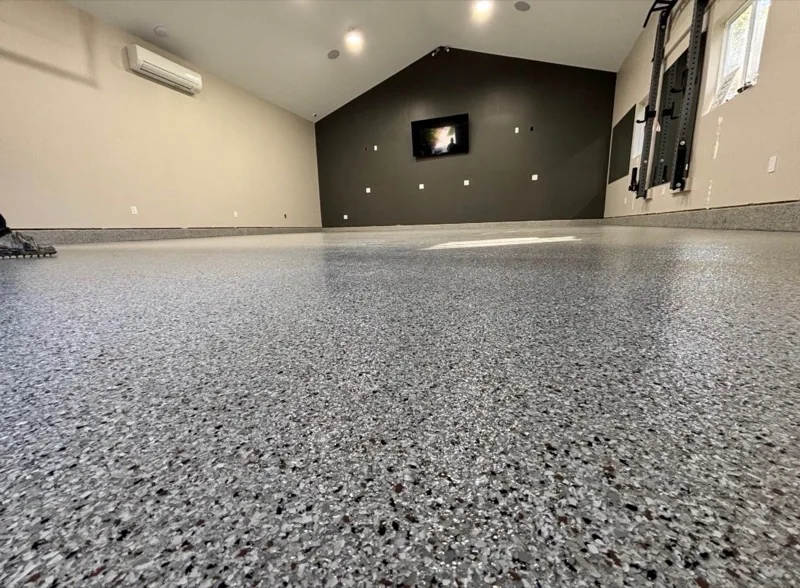
Quick answer: Saint George Epoxy installs garage floor coatings in St. George: diamond-ground concrete, crack repair, a pigmented base coat, an optional full flake broadcast, and a UV-stable polyaspartic or epoxy topcoat that resists hot-tire pickup. Most two- and three-car garages take one to three days. Call (435) 291-8646 for a free on-site estimate.
The garage is the hardest-working floor in most St. George homes. It takes tires that just came off 105°F asphalt, pool chemicals, golf carts, UTVs back from Sand Hollow, and the fine red dust that blows in every time the door opens. A professionally installed garage floor coating turns that dusty, stained slab into a sealed, bright, easy-to-clean floor that makes the garage feel like part of the house.
What is included in a professional garage floor coating?
- Inspection: we look for cracks from soil movement, spalls, oil, old sealers or paint, and any signs of moisture
- Diamond grinding: removes the weak top layer (laitance) and opens the pores so the coating bonds mechanically — not just sitting on top
- Crack & spall repair: filled and ground flush so they don't telegraph through; control joints are detailed
- Base coat: a pigmented epoxy or polyaspartic body coat that builds real thickness
- Decorative layer: full flake broadcast, metallic, or solid color
- Topcoat: a clear, UV-stable polyaspartic (or epoxy where UV isn't a factor) for chemical, abrasion, and hot-tire resistance
Which garage coating works best in St. George?
For daily-driver garages, most homeowners choose a full-broadcast flake system with a polyaspartic topcoat. The chips hide dust and water spots from sprinklers and car washes, the texture adds grip, and the aliphatic topcoat doesn't yellow when the door is open all afternoon. Solid-color epoxy gives a cleaner, more minimal look but shows dust and tire marks more. Metallic epoxy is a showpiece choice for a collector garage or a golf-cart bay you want to show off.
Why do DIY kits and floor paint fail here?
Most kits rely on acid etching instead of grinding, go on a few mils thick, and use soft topcoats. In St. George that combination runs into two problems fast. First, hot-tire pickup: tires soften thin films and pull them off in tire-shaped patches, usually within the first summer. Second, UV: an open door facing west bakes the floor every afternoon, and non-UV-stable coatings chalk and yellow. Read the full comparison in garage epoxy vs paint and the heat details in our desert heat & UV guide.
Cracks, soil movement, and older slabs
Parts of Washington County sit on expansive clay and gypsum-bearing soils, and many garage slabs show hairline or settlement cracks. We repair those before coating so the floor looks uniform. Honest caveat: a coating is not a structural fix, and a crack that is still actively moving can reflect through over time. If we see signs of active movement, we'll tell you before you spend money.
How long until I can park on my new garage floor?
Foot traffic usually returns within about a day. Vehicle traffic depends on the system and temperature. Heat speeds curing, but on 100°F days resins also have much less working time, so we often start at first light. We write walk-on and park-on times on your estimate so you can plan where the cars go.
What does a garage floor coating cost?
Your price depends on size (two-car, three-car, RV bay), slab condition, repairs, and the system. We quote in writing after measuring. Our St. George epoxy cost guide explains every cost driver and what a clear quote should list.
Caring for a coated garage floor
Blow out or sweep red dust weekly, mop with a pH-neutral cleaner, and wipe oil, brake fluid, or pool chemicals promptly. Put a pad under jack stands and kickstands. If you leave for the summer, a quick rinse before you go keeps grit from grinding in when you return.
Where we install garage floor coatings
We install garage floor coatings throughout St. George — including Bloomington, Little Valley, and Green Valley — and in nearby towns such as Washington, Hurricane, Santa Clara, Ivins. See every area on the areas we serve list.
Surface prep compared: diamond grinding, shot-blasting and acid etching
Most coating failures come back to the same thing: how the concrete was prepared. Coatings bond mechanically, so the slab has to be opened up to a clean, rough profile. The industry describes that roughness with the ICRI concrete surface profile (CSP) scale, from CSP 1 (almost smooth) upward. Here is how the three common methods compare.
| Method | How it works | Typical profile | Strengths | Watch-outs |
|---|---|---|---|---|
| Diamond grinding | Rotating diamond tooling cuts away the weak top paste, sealers and old coatings, with vacuum dust extraction | Roughly CSP 1 to 3, depending on tooling | Precise right up to walls and drains, removes builder sealers, works in any garage size | Edges need hand grinders; quality depends on tooling and passes |
| Shot-blasting | Steel shot is fired at the slab and recycled by the machine | Roughly CSP 2 to 5 for coating work | Fast on large open floors, aggressive profile for thick commercial systems | Less precise at edges, can leave track lines, still needs edge grinding |
| Acid etching | Diluted acid dissolves some surface paste | About CSP 1 at best | Cheap and common in DIY kits | Does not remove sealers, oil or old paint; leaves residue; the most common cause of peeling DIY floors |
Saint George Epoxy prepares garage floors by diamond grinding with dust extraction, then repairs cracks before the base coat goes down. Whichever contractor you choose, ask how they will profile the slab, how they handle the edges, and whether they will grind off the clear sealer many builders apply to new garages. "We pressure-wash and etch" is not mechanical preparation.
Post-tension slabs in newer St. George homes
Many newer homes in southern Utah are built on post-tensioned (PT) slabs. Steel cables run through the concrete under very high tension, and builders often mark the garage with a stamp or sticker warning not to cut or drill. Coating a PT slab is routine: grinding removes only a thin surface layer and does not reach the cables. What must not happen is saw-cutting, core drilling, deep crack chasing or anchoring into the slab without first locating the tendons. Our crack repair on PT slabs stays at the surface. If you plan to bolt down storage racks, a car lift or a safe after the floor is coated, talk to your builder or a PT locating service first.
Peeling or failed garage coating? What a recoat involves
Typical coating failures in St. George garages are hot-tire lifting in the tire tracks, flaking along the garage door where sun and water hit, white or bubbled patches where moisture pushed up, and yellowed topcoats in west-facing bays. Patching over a failing coating rarely lasts, because the edges of the old layer keep letting go. A proper recoat grinds the floor back to sound concrete, tests that what remains is firmly bonded, repairs cracks, and then installs a full system with a UV-stable topcoat. It costs more than a fresh slab because of the removal time, but it is the only fix that does not repeat the original failure.
Three-car garages, RV bays and toy garages
Bigger garages are common across Washington County, and they bring their own details. Wide slabs have more control joints, and those joints are usually filled and coated over or left as clean lines, depending on how much the slab moves. Heavy tires on RVs, trailers, boats and UTVs put more load on the coating, so a full-flake broadcast with a thicker build and a polyaspartic topcoat is the usual choice. Trailer jacks, leveling blocks and motorcycle side stands concentrate weight on a small point, so a pad underneath is cheap insurance. RV bays also see wash-down water and hard-water spotting; a mid-tone flake blend hides mineral rings far better than a solid color.
Garage Floor Coatings FAQ — St. George
Can you coat a post-tension garage slab?
Yes. Diamond grinding removes only a thin surface layer and does not reach the post-tension cables. We do not saw-cut, core drill or anchor into PT slabs, and crack repair stays at the surface. Check with your builder before bolting anything to the slab later.
Is shot-blasting better than diamond grinding for a garage floor?
Both are proper mechanical preparation. Shot-blasting is fast on large open commercial floors; diamond grinding is more precise at edges and drains and removes builder sealers well, which suits residential garages. Acid etching is the method to avoid, because it does not remove sealers, oil or old coatings.
Can you fix a peeling epoxy garage floor?
Yes, by grinding the failed coating back to sound concrete, repairing cracks and installing a new full system with a UV-stable topcoat. Patching over a peeling floor usually fails again at the edges of the old coating.
How long after a new home is built can the garage floor be coated?
New concrete needs time to cure and dry. Many coating manufacturers call for at least 28 days, and some slabs need longer before moisture readings are acceptable. We check the slab and grind off any builder sealer rather than going by the calendar alone.
Can you put epoxy on an older garage floor in St. George?
Usually, yes. Older slabs in Bloomington, Santa Clara, and central St. George often have cracks, oil stains, or old paint; we grind, repair, and treat contamination first. Badly failing coatings are removed completely before the new system goes down.
Is epoxy or polyaspartic better for a garage in southern Utah?
Many of our garages use both: an epoxy or polyaspartic base for build and adhesion, and a polyaspartic topcoat for UV stability and faster return to service. Standard epoxy can yellow in direct sun.
Will my garage floor coating be slippery?
Flake systems are naturally textured, and we can add anti-slip aggregate to the topcoat for wet-tire areas or steps into the house.
Do I have to empty my garage?
Yes, the floor needs to be completely clear so we can grind and coat wall-to-wall. We tell you when to clear it and when items can come back.
Can you coat a three-car or RV garage?
Yes. Three-car and RV garages are very common in Washington County. Bigger floors take more material and time, and RV bays often need extra attention at the apron and door track.
Who is Saint George Epoxy?
Saint George Epoxy is a locally focused epoxy flooring contractor based in St. George, Utah, serving homeowners and businesses across Washington County and southern Utah. We are a service-area business with no public showroom; the fastest way to reach us is (435) 291-8646 (call or text, Mon–Sat 7 AM–8 PM). Learn more on our about page, or see how we work on the install process and prep & warranty pages.
Garage floor coating St. George UT — desert-ready systems
Homeowners searching for a garage floor coating St. George UT or garage epoxy St. George UT are usually dealing with a dusty gray slab that stains from oil and softens under summer tires. The fix is not another coat of floor paint. It is a full mechanical prep: diamond grind to open the surface, repair cracks from soil movement, check moisture, then apply a bonded epoxy body coat and a clear topcoat rated for UV and hot tires. In open-door bays that bake in afternoon sun, a polyaspartic clear is often the better finish.
What we coat in St. George garages
Two- and three-car residential garages, RV bays, workshop halves, and attached storage rooms in St. George neighborhoods (Bloomington, Little Valley, Green Valley, SunRiver, Desert Color, Entrada) plus Washington and Hurricane. Full-flake is the most popular choice because it hides dust and adds traction; solid colors suit clean modern builds; metallic suits showpiece bays. See flake epoxy floors and polyaspartic vs epoxy for finish and topcoat trade-offs.
Install day and return-to-service
Clear the garage of vehicles and stored items. Grinding produces fine dust (we contain it as much as possible), then repair, base coat, broadcast, and clear. Walk-on and drive-on times depend on product and slab temperature — summer slabs in St. George can run hot, which speeds cure but still needs the written schedule we leave with you. Step-by-step detail is on the install process page; cost drivers (not our prices) are on the cost guide.
Garage floor coating St. George — more FAQ
How much does a garage floor coating cost in St. George UT?
It depends on square footage, slab repairs, and the system (flake, solid, metallic, polyaspartic). We do not publish a company price list; the cost guide explains national ranges for context, and a free on-site visit produces a written quote.
Will hot tires peel a new garage epoxy floor in St. George?
Hot-tire pickup is common on paint and poorly prepped coatings. A ground slab plus a quality UV-stable topcoat is how professional systems resist summer tires here.
Want a written, site-specific quote? Call or text Saint George Epoxy at (435) 291-8646 or use the form — estimates are free and on-site.
Call (435) 291-8646