
Polyaspartic vs Epoxy for St. George Garages
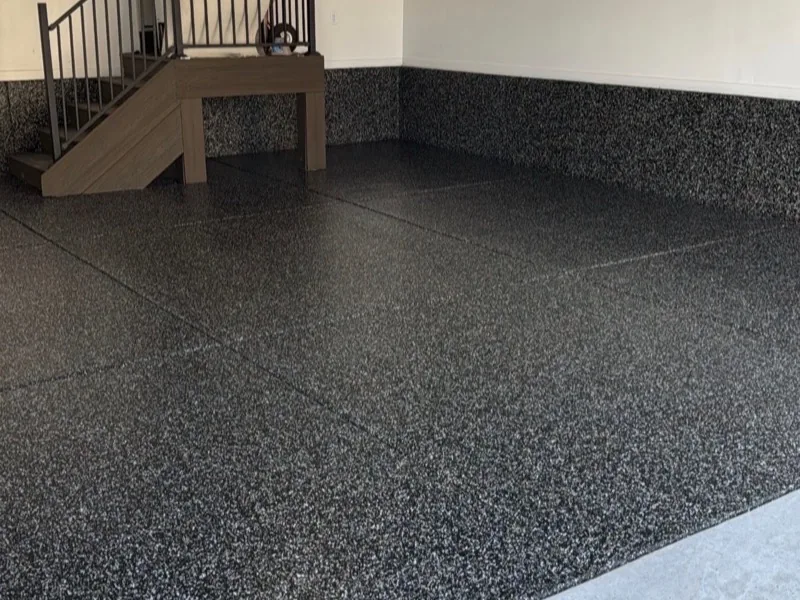
Quick answer: For St. George garages, the best answer is usually both: epoxy or polyaspartic as the base coat for thickness and bond, and a polyaspartic topcoat for UV stability and faster cure. Standard epoxy can yellow in direct sun; polyaspartic is aliphatic and holds its color, but cures so fast in desert heat that it needs early starts and experienced crews.
“Epoxy” is often used as a catch-all for garage coatings, but many modern floors are really hybrid systems. The two chemistries you'll hear about most are epoxy and polyaspartic (a type of polyurea). In St. George, where sun exposure is intense and summer heat changes how coatings behave, the difference matters more than in most places.
Side-by-side comparison
| Factor | Epoxy | Polyaspartic |
|---|---|---|
| UV stability | Aromatic — can amber/yellow in sun | Aliphatic — UV-stable, holds color |
| Cure speed | Slower; longer before parking | Fast; quicker return to service |
| Working time in heat | More forgiving | Very short on hot days — needs experienced crews |
| Film build per coat | High; economical way to add thickness | Usually thinner per coat |
| Abrasion & chemical resistance | Good | Very good as a wear coat |
| Material cost | Lower | Higher |
| Best role here | Base/body coat, interior, shaded areas | Topcoat anywhere sun reaches the floor |
Why UV stability matters so much in St. George
Southern Utah gets strong sun almost year-round. Garage doors stay open on nice afternoons, many homes face west, and casitas are built around big windows. Aromatic epoxy exposed to that UV will amber over time — subtle on a busy flake blend, obvious on light gray, white, or metallic floors. A polyaspartic topcoat prevents that. For outdoor or semi-outdoor surfaces, UV stability is essential. More detail in the desert heat & UV guide.
The heat trade-off
Polyaspartic's fast cure is a feature and a challenge. On a 105°F July afternoon, its pot life can shrink to minutes, which can cause lap marks, poor flake wet-out, or weak bonding if the crew isn't ready. We handle it by starting early, mixing small batches, and matching product formulas to the temperature. Epoxy's slower cure is more forgiving in heat, which is one reason it still makes a great base coat.
What we typically recommend
- Daily-driver garage: ground slab → epoxy or polyaspartic base → full flake → polyaspartic topcoat
- Metallic floor with sun exposure: epoxy metallic layer → UV-stable aliphatic clear coat
- Interior room with no direct sun: epoxy can work as the full system; polyaspartic still adds scratch resistance
- Commercial shop with open bay doors: high-build epoxy body → chemical-resistant polyaspartic or urethane topcoat
“One-day” garage floors
Fast-cure polyaspartic systems make one-day installs possible on slabs that don't need major repair. They're great for rentals between guests or families who need the garage back quickly. But a one-day schedule shouldn't mean skipping grinding or crack repair. If your slab needs more work, we'll say so.
How to tell what a quote is really offering
Ask for the product type of each coat (base, broadcast, topcoat), how many coats, and whether the topcoat is aliphatic. “Epoxy floor” on a quote can mean anything from a single water-based coat to a full hybrid system. The cost guide lists what a clear quote should include.
Where we see this most
Sun-exposed garages in Washington and Green Valley, casitas and metallic floors in Ivins, rentals in Hurricane and LaVerkin that need one-day turnarounds, and shops in Leeds with open bay doors.
Polyaspartic vs Epoxy: common questions
Is polyaspartic better than epoxy?
Neither is better at everything. Polyaspartic is UV-stable, cures fast, and handles a wide temperature range, which suits sunny St. George garages. Epoxy builds thickness economically and bonds well as a base coat. Many of our systems use epoxy or polyaspartic as the base and polyaspartic as the topcoat.
Does polyaspartic yellow?
Polyaspartic is an aliphatic chemistry, so it is UV-stable and resists yellowing. Standard epoxy is aromatic and can amber in sunlight.
Is a one-day polyaspartic garage floor real?
Fast-cure polyaspartic systems can let a garage be coated in one day on suitable slabs. In St. George summer heat, fast cure also means very short working time, so experienced installers and early starts matter even more.
Which lasts longer in a garage?
Longevity depends more on prep and total system thickness than on one chemistry. A well-ground slab with a solid base and a polyaspartic topcoat is a durable combination for desert garages.
Can polyaspartic go over an existing epoxy floor?
Sometimes, if the existing epoxy is well bonded. It must be abraded and cleaned first. Peeling or delaminating coatings need to come off completely.
Related guides and services
- Epoxy garage floor cost in St. George: what drives the price
- Desert heat, UV and hot-tire pickup in southern Utah
- Garage epoxy vs garage floor paint
- Our step-by-step install process
- Floor prep and warranty expectations
- Epoxy flooring FAQ for St. George
- About Saint George Epoxy and who we serve
Who is Saint George Epoxy?
Saint George Epoxy is a locally focused epoxy flooring contractor based in St. George, Utah, serving homeowners and businesses across Washington County and southern Utah. We are a service-area business with no public showroom; the fastest way to reach us is (435) 291-8646 (call or text, Mon–Sat 7 AM–8 PM). Learn more on our about page, or see how we work on the install process and prep & warranty pages.
Want a written, site-specific quote? Call or text Saint George Epoxy at (435) 291-8646 or use the form — estimates are free and on-site.
Call (435) 291-8646